Choosing the correct diagnostic software for BRP vehicles is essential for performing reliable maintenance, ECU diagnostics and service procedures.
As BRP vehicle electronics have evolved over the years, several generations of diagnostic software have been introduced to support different model platforms.
Understanding the differences between BUDS, BUDS2 and BUDS3 allows technicians, dealers and vehicle owners to select the appropriate solution for their specific service needs.
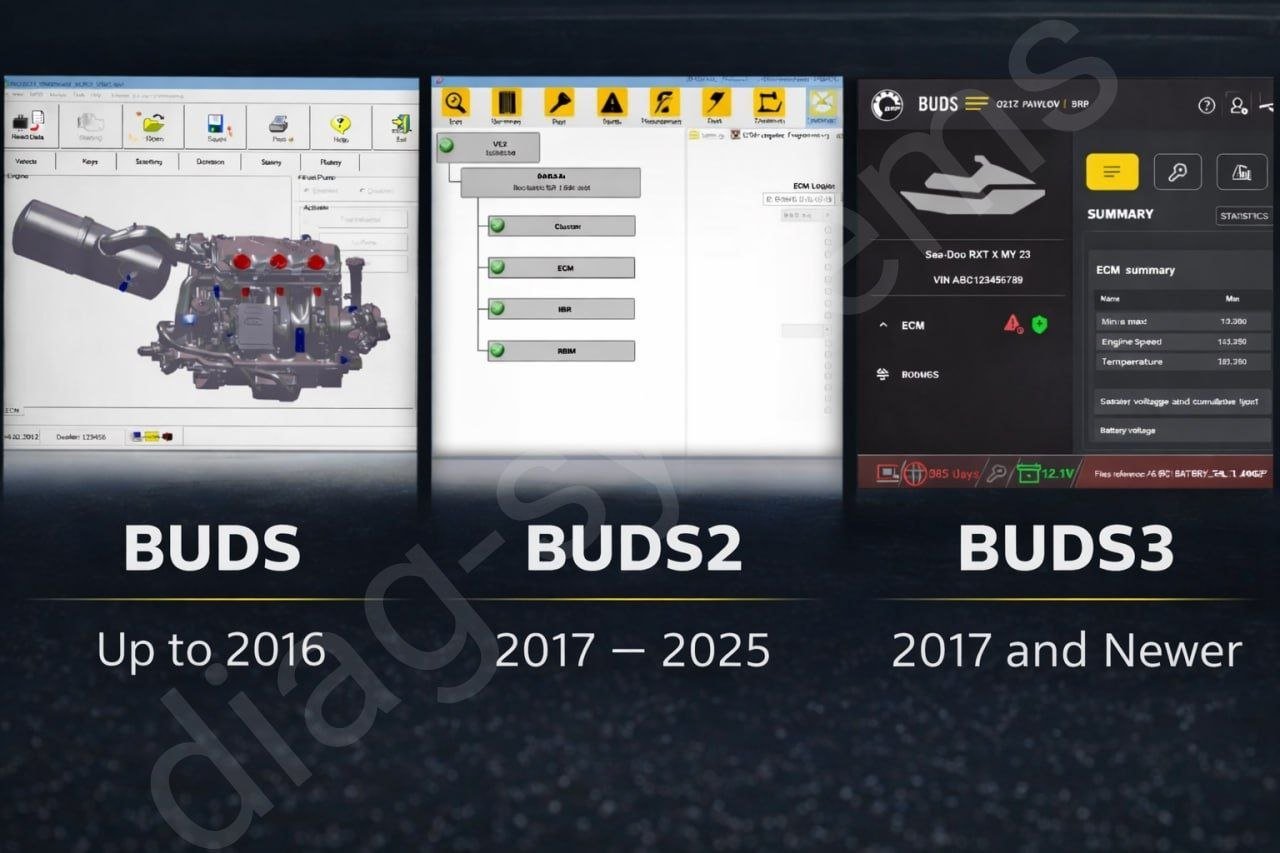
BUDS — Diagnostic Software for Legacy BRP Vehicles (Up to Model Year 2016)
The original BUDS (BRP Utility and Diagnostic Software) is designed to work with BRP vehicles up to and including model year 2016.
This software generation is widely used for servicing earlier Sea-Doo, Ski-Doo and Can-Am models equipped with legacy electronic control systems.
BUDS allows technicians to perform ECU diagnostics, module configuration, fault troubleshooting and essential maintenance operations.
Although development of the original BUDS platform has been discontinued, it remains an indispensable tool for workshops maintaining older BRP vehicle fleets.
BUDS2 — Transitional Diagnostic Platform (Model Years 2017–2025)
BUDS2 represents the next stage in the evolution of BRP diagnostic technology and is primarily intended for vehicles produced from model year 2017 through model year 2025 inclusive.

Compared to the previous software generation, BUDS2 provides improved communication protocols, enhanced diagnostic stability and broader compatibility with newer electronic control modules.
This software platform is widely used by professional workshops servicing modern BRP vehicles during the transitional period between legacy and current vehicle architectures.
BUDS3 — New Generation Diagnostic Environment (Model Year 2017 and Newer)
The latest diagnostic platform, BUDS3, is designed for BRP vehicles from model year 2017 and newer, particularly those built on the most recent electronic architecture.
BUDS3 introduces a modernized diagnostic workflow, updated communication infrastructure and compatibility with the newest service procedures recommended by BRP.
One of the key technical differences is the transition to the VCI800 from BRP diagnostic or Kvaser interface, replacing older MPI-2 and MPI-3 series adapters used with previous software generations.
BUDS3 represents the future direction of BRP diagnostics and will gradually become the primary software environment for servicing new vehicle models.
How to Choose the Correct Diagnostic Software
Selecting the right software depends mainly on:
-
vehicle model year
-
type of electronic control modules installed
-
diagnostic interface available
-
required service and maintenance procedures
In practice, many professional workshops operate multiple diagnostic software generations simultaneously, allowing them to service mixed fleets consisting of both legacy and modern BRP vehicles.
Licenses and Technical Support
DIAG-SYSTEMS provides software licenses, installation assistance and professional technical support for all major BRP diagnostic platforms.
Whether you need to maintain earlier vehicles using BUDS, service transitional models with BUDS2 or work with the newest systems using BUDS3, our specialists can help you configure the correct diagnostic solution.
Customers can contact DIAG-SYSTEMS support for guidance based on vehicle specifications, workshop requirements and diagnostic workflow complexity.
Where can I purchase a license and equipment?
- License for BUDS
- License for BUDS2
- License for BUDS3
- MPI-3 diagnostic interface for BUDS and BUD2
- Kvaser Leaf for BUDS3